
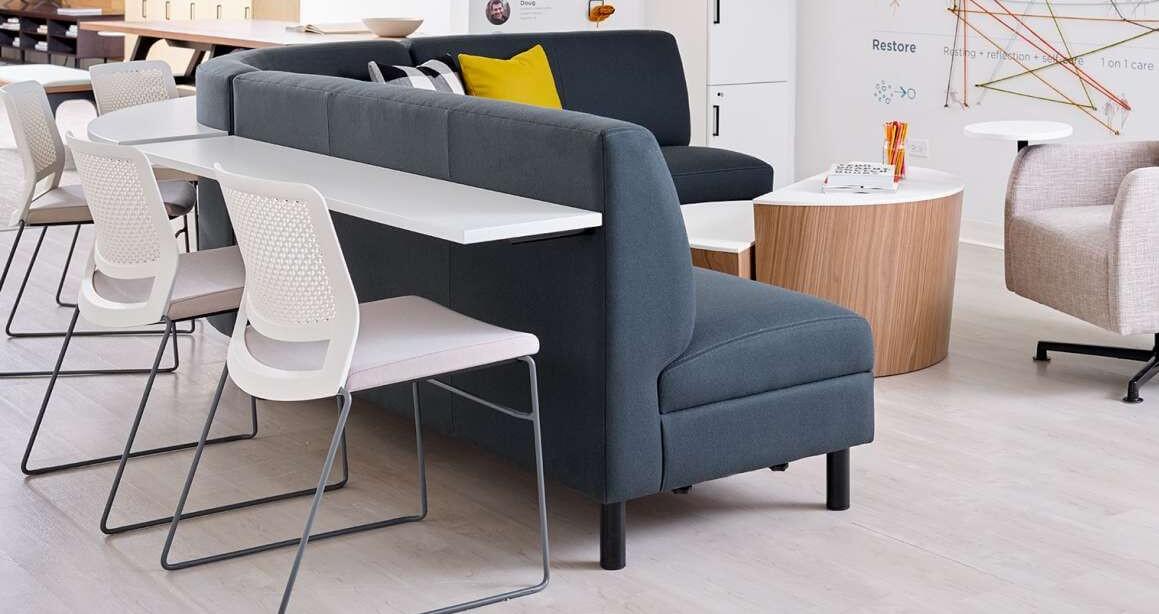
Breakroom & Employee Lounge Furniture Ideas That Support Retention
August 10th, 2026 | Office Furniture Blog
Most companies treat the breakroom as an afterthought. A fridge, a folding table, a few mismatched chairs, done. But the breakroom is one of the only spaces in the office where employees are not performing for anyone. That makes it one of the most honest signals of how a company actually treats its people, and increasingly, a factor in whether people stay.
The Breakroom Is a Retention Tool, Not Just a Perk
Employees don’t leave jobs only over salary. They leave over how a workplace makes them feel day to day, and burnout is a leading driver of turnover. A well-designed breakroom gives people permission to actually step away from their desks, which matters more than it sounds. If the only place to eat lunch is a hard plastic chair under fluorescent lighting, most employees will eat at their desks instead, skip the mental reset, and burn out faster.
This is why breakroom design belongs in the same conversation as compensation and benefits when you’re thinking about retention. For a deeper look at the connection between workplace environment and how engaged your team stays, our guide on how to motivate employees in your workplace covers the broader picture this space fits into.
Design for Recharging, Not Just Coffee Runs
The best breakrooms give people a real menu of options, because not everyone recharges the same way.
- Social seating such as booths or a communal table for employees who want to chat with coworkers
- Soft lounge seating like low sofas or armchairs for people who want to sit quietly with a podcast or a book
- A few standing high-tops for a quick coffee between meetings without committing to a full seated break
Variety matters more than square footage here. A small breakroom with two or three distinct seating styles will get used far more often than a large one with a single long table.
Bring in Cafe-Style Furniture for a Genuine Change of Scenery
One of the simplest upgrades is furniture that doesn’t look like the rest of the office. Bistro tables, cafe chairs, and warmer materials signal that this space operates on different rules than the workstations down the hall, and that psychological shift is part of what makes a break feel like a break. We rounded up some of our favorite pieces for exactly this purpose in our favorite cafe settings, which are built for comfort over long stretches without feeling like conference room furniture that wandered into the wrong room.
Zone the Space for Different Kinds of Breaks
If square footage allows, resist the urge to treat the breakroom as one undifferentiated zone. A simple layout that separates a louder social area from a quieter corner lets employees choose the kind of break they actually need that day. Even a bookshelf, a storage unit, or a change in flooring can act as a soft divider without requiring a full wall.
Storage Keeps a Good Breakroom From Becoming a Bad One
Breakrooms fall apart fast without enough storage. Dishes pile up, personal mugs colonize every open shelf, and supplies end up stacked on counters because there’s nowhere else to put them. Built-in cabinetry, lockers for personal items, and dedicated shelving keep the space looking intentional instead of chaotic, which matters for how much employees actually want to spend time there. Our guide on creative office storage ideas has practical options that work well in shared spaces like this one, not just at individual desks.
A Breakroom That Works as Hard as Your Team
The companies that get this right treat the breakroom as part of the employee experience, not a compliance requirement or an afterthought once the “real” office is furnished. Every element, from the seating to the storage to the small details like lighting and layout, adds up to whether people actually use the space to recharge or just tolerate it.
If your breakroom hasn’t been rethought in a while, it might be one of the highest-impact, lowest-cost upgrades available to you. Arenson Office Furniture works with San Diego companies to design breakrooms and lounge spaces that employees actually want to use. Reach out to our team to talk through what would work best for your space.
LATEST POSTS
New vs. Refurbished Office Furniture: A San Diego Buyer’s Guide
November 7th, 2026 | Office Furniture Blog
The short answer Refurbished furniture costs less and is usually in stock, so it ships faster. It’s best for tight budgets, quick move-ins and core pieces like filing cabinets and cubicle panels. New furniture gives you the full manufacturer warranty, exact finish matching and the latest ergonomic features. It’s best for large rollouts, executive spaces…
Read MoreWhat Is a Standing Desk? Types, Benefits & How to Use One
October 31st, 2026 | Office Furniture Blog
Standing desks have gone from a niche office trend to a mainstream productivity tool, and for good reason. If you’re wondering whether one is right for you, this guide breaks down exactly what a standing desk is and why it might be the best upgrade you make to your workspace. What Is a Standing Desk?…
Read MoreHealthcare Facility Furniture: A Room-by-Room Guide for Clinics and Medical Offices
October 31st, 2026 | Office Furniture Blog
The short answer Healthcare furniture has four extra demands beyond office furniture: daily disinfection, infection-control design, patients of every size and mobility level, and round-the-clock use. Waiting rooms: Mix standard, bariatric and higher-seat chairs. Aim for about 10–15% bariatric seating, spread through the room, with sturdy arms and a clean-out gap. Clinical spaces: Exam rooms…
Read More