
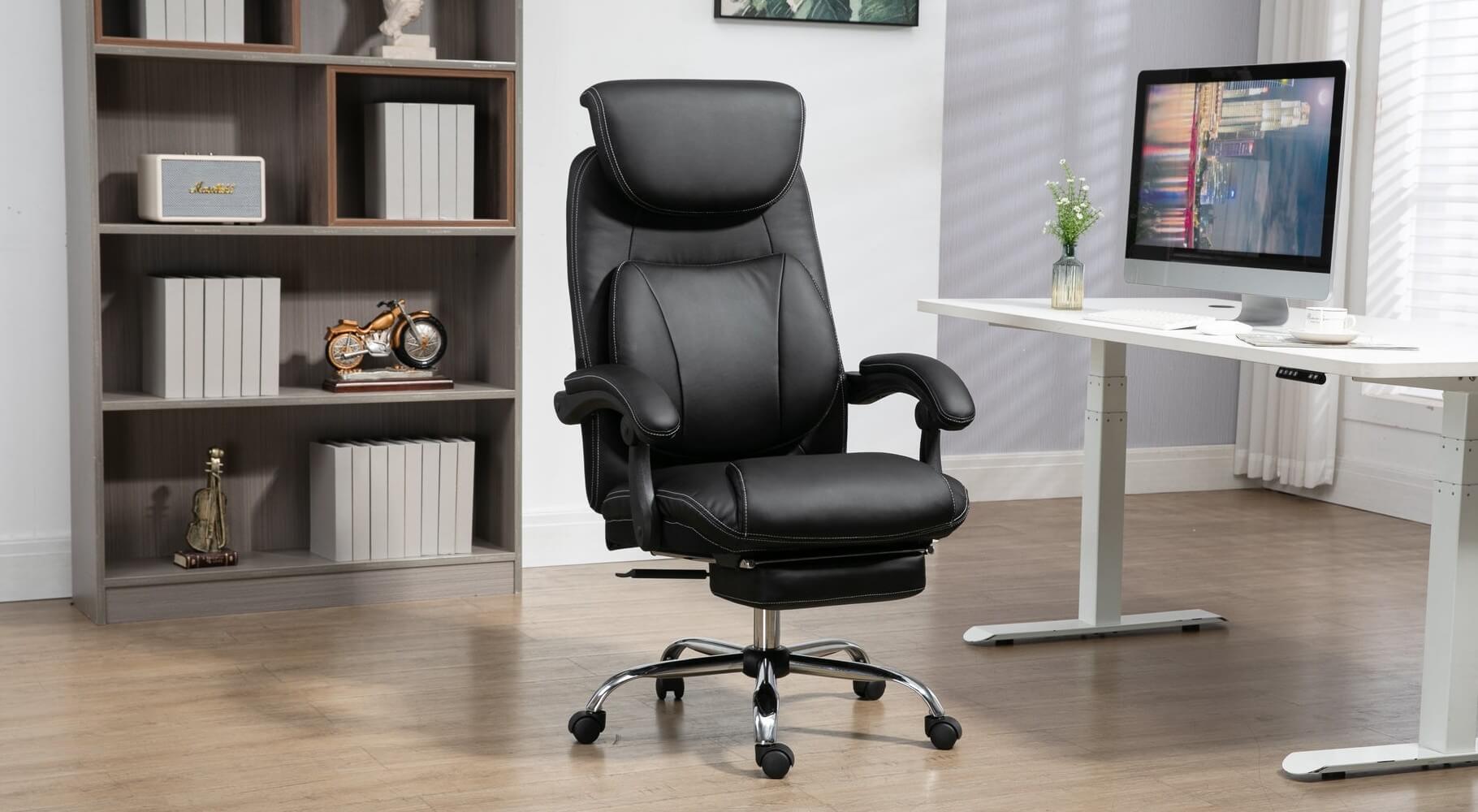
How to Choose a Big and Tall Office Chair (What Actually Matters)
October 12th, 2026 | Office Furniture Blog
A standard office chair is designed around an average body. If you are taller, broader or heavier than average, you have probably felt where that design falls short: armrests that pinch your hips, a seat that ends halfway down your thighs, a backrest that stops below your shoulder blades, or a chair that slowly sinks and creaks after a few months.
That is not a comfort problem you have to live with. It is a sizing and engineering problem, and a properly built big and tall chair solves it. This guide explains what separates a true big and tall chair from a regular chair with a wider cushion, which specs matter most, and how to test one before you commit.
Who needs a big and tall office chair?
You are a good candidate if any of these sound familiar:
- You weigh more than about 250 lbs, which is where standard chair testing stops (more on that below).
- You are over roughly 6’2″ and your knees sit higher than your hips, or the seat ends well before your knees.
- Standard armrests press into your hips or thighs, even at their widest setting.
- The top of the backrest hits mid-back instead of supporting your shoulders.
- Your current chair has started to lean, sink, wobble or squeak within its first year or two.
Big and tall chairs are also a smart choice for shared seats used by many different people, such as reception desks, security stations, dispatch desks and conference rooms. A chair that comfortably fits the largest person in the rotation fits everyone else too.
What makes a chair “big and tall”?
The term is not regulated, so anyone can put it on a product listing. What matters is how the chair is built and tested.
The furniture industry’s standards body, BIFMA, tests general-purpose office chairs (ANSI/BIFMA X5.1) using a 253-lb user, the 95th percentile male. For larger users, BIFMA created a separate standard, ANSI/BIFMA X5.11 for large occupant office chairs. It bases its tests on a 400-lb user and requires a seat at least 22 inches wide.
In practice, a genuine big and tall chair has three things a regular chair does not:
- A higher, tested weight rating, typically 350 to 500 lbs.
- Larger dimensions: a wider and often deeper seat, a taller back and wider-set arms.
- Heavier-duty components: base, gas cylinder, tilt mechanism and casters built for the load.
The 8 specs that matter most
1. Weight capacity, with headroom
Start here, because every other component depends on it. Choose a chair rated at least 50 lbs above your body weight. People do not sit still: dropping into a chair, leaning back and rocking all put momentary loads on the frame well above your static weight. Headroom is what keeps the chair stable for years instead of months.
Ask whether the rating comes from testing to BIFMA X5.11 or the manufacturer’s own testing. A tested rating from a commercial manufacturer means more than a number on an online listing.
2. Seat width
You should be able to sit with a little space on each side of your hips, without your thighs pressing against the armrests or hanging over the seat edge. BIFMA’s large occupant standard sets 22 inches as the minimum, and many big and tall chairs go wider.
Measure your seated hip width and add 2 to 4 inches. That is your target.
3. Seat depth
Depth matters most for taller users. When you sit all the way back, you want about two to four fingers of space between the front edge of the seat and the back of your knees. Too short, and your thighs are unsupported, putting pressure on your lower back. Too long, and the edge cuts into the back of your knees. A seat slider, which lets you move the seat pan forward and back, is the best solution for tall users.
4. Seat height range
With your feet flat on the floor, your thighs should be roughly parallel to the ground and your knees at or slightly below hip level. Tall users often need a higher maximum seat height than standard chairs offer, while some heavier users of average height need a standard range. Check the range, not just the maximum, and see our guide to standard office chair height for how to measure.
5. Backrest height and lumbar support
A tall user needs a backrest that reaches at least the shoulder blades, and ideally a headrest for reclined work and calls. The lumbar curve must also sit in the right place: on a taller torso, fixed lumbar support often lands too low. Look for height-adjustable lumbar or a backrest that moves up and down. Our post on office chairs with lumbar support explains what good lumbar support feels like.
6. Armrests
Armrests are the most common complaint from larger users. Look for arms that are set wide, adjust in height, and ideally pivot or slide in and out. Your shoulders should stay relaxed with your elbows at about 90 degrees. Fixed, narrow arms are the fastest way to turn a good chair into an uncomfortable one.
7. Base, cylinder and casters
This is where cheap “big and tall” chairs cut corners, because buyers rarely look underneath. On a heavy-duty chair, look for:
- A steel or reinforced base with a wide footprint for stability when reclining.
- A heavy-duty gas cylinder rated for the chair’s full capacity. A worn or undersized cylinder is why chairs slowly sink.
- Larger, durable casters that roll easily under load and suit your floor (hard casters for carpet, soft-tread casters for hard floors).
8. Tilt mechanism and build
The tilt mechanism carries your weight every time you lean back. Choose a heavy-duty mechanism with adjustable tension, so you can set how easily the chair reclines for your body weight, and a tilt lock. A thick, high-density foam seat also matters. Low-density foam compresses quickly under more weight, and within months you are sitting on the seat pan.
Quick reference: big and tall chair specs
| Feature | Standard office chair | What to look for in big and tall |
|---|---|---|
| Tested weight rating | Up to 253 lbs (BIFMA X5.1) | 350–500 lbs; ideally tested to BIFMA X5.11 (400 lbs) |
| Seat width | Often under 22″ | 22″ or wider |
| Seat depth | Fixed, average | Deeper, or adjustable with a seat slider |
| Backrest | Mid-back common | High back reaching the shoulders; headrest a plus |
| Armrests | Fixed or height-only | Wide-set, height and width adjustable |
| Base and cylinder | Standard duty | Steel or reinforced base, heavy-duty cylinder |
| Seat foam | Standard density | High-density, contoured foam |
Mesh or padded? Choosing the right style
Big and tall chairs come in the same styles as standard chairs. The right one depends on how you work and how warm you run.
- Padded executive chairs offer the plushest sit, with thick cushioning and a high back. They suit private offices and long, seated workdays. The trade-off is heat: padding and leather-style upholstery hold warmth.
- Mesh-back chairs breathe, which many larger users appreciate, especially in warmer offices. Pair a mesh back with a well-padded, high-density seat for the best of both. Our leather vs. mesh comparison goes deeper.
- Intensive-use (24/7) chairs are built for shift work, such as dispatch, security and call centers, where several people use one chair around the clock. They usually combine heavy-duty components with simple, robust adjustments.
- Big and tall guest and conference chairs matter too. A visitor who cannot fit comfortably into your reception or conference seating notices. Mixing one or two wider chairs into a set is a thoughtful, low-key fix.
Big and tall chairs available at Arenson
These three chairs, all rated to 400 lbs, are available to see and test at our San Diego showroom:
| Chair | Style | Weight capacity | Best for |
|---|---|---|---|
| Proline Big and Tall Executive Chair | Padded executive, contoured seat, built-in lumbar | 400 lbs | All-day seated work in a private office |
| Proline Big and Tall Mesh Back Chair | Breathable mesh back, padded contour seat, built-in lumbar | 400 lbs | Users who run warm; open offices |
| Boss Executive Big and Tall Chair | Pillow-top cushioning, padded arms on a steel wrap-around frame | 400 lbs | Executive offices, boardrooms, home studies |
Our team can also source larger-occupant models from our manufacturer partners if you need a different size, capacity or finish.
How to test a big and tall chair in 5 minutes
Specs narrow the list, but your body makes the final call. When you try a chair in person, run through this checklist:
- Sit all the way back. Check for two to four fingers of space between the seat edge and the back of your knees.
- Set the height. Feet flat, thighs roughly level, knees at or slightly below your hips. If you hit the top or bottom of the range, it is the wrong chair.
- Check your hips. You should have room on both sides without touching the arms.
- Find the lumbar. The curve should meet the small of your back, not your belt line or your mid-back.
- Lower the arms to desk height. Shoulders relaxed, elbows near 90 degrees, arms not pushing your elbows outward.
- Lean back and rock. The chair should feel planted, with no flex, creak or wobble. Adjust the tilt tension until it supports you through the recline.
- Stand up and sit down a few times. The cylinder should not drop and the seat should not bottom out.
After purchase, take ten minutes to fine-tune every adjustment. Our step-by-step guide on how to adjust your office chair walks through the right order.
5 mistakes to avoid
- Trusting the label. “Big and tall” is a marketing term. Check the tested weight rating and the seat dimensions.
- Buying at your exact weight. Choose a capacity with at least 50 lbs of headroom.
- Forgetting the desk. A higher seat may need a taller desk or keyboard tray. A height-adjustable desk solves this for most tall users.
- Ignoring the armrests. Narrow fixed arms make an otherwise good chair unusable.
- Buying sight unseen. Fit is personal. Whenever possible, sit in the chair before you buy, or work with a dealer who will help you get the fit right.
Frequently asked questions
What is the weight limit of a standard office chair? Most general-purpose office chairs are tested to the BIFMA X5.1 standard, which is based on a 253-lb user. Above that, choose a chair specifically rated and built for larger users.
What weight capacity should a big and tall chair have? At least 50 lbs more than your body weight. Most quality big and tall chairs are rated between 350 and 500 lbs, and BIFMA’s large occupant standard tests to 400 lbs.
How wide should a big and tall office chair seat be? At least 22 inches, the minimum in BIFMA’s large occupant standard. Measure your seated hip width and add 2 to 4 inches for comfortable clearance.
Are big and tall chairs only for heavier people? No. Tall users of average weight often benefit most from the deeper seat, higher seat range and taller backrest. Big and tall chairs also suit shared seats used by many different people.
Is a gaming chair a good big and tall option? Usually not for full workdays. Gaming chairs often prioritize looks over adjustability and long-term durability. Our gaming chair vs. office chair comparison explains the differences.
Why does my office chair keep sinking? A sinking chair almost always means a worn or undersized gas cylinder. Big and tall chairs use heavy-duty cylinders rated for higher loads to prevent it.
Find your fit at our San Diego showroom
The best way to choose a big and tall chair is to sit in a few. At Arenson Office Furniture, you can test big and tall seating side by side with standard models and get help from a team that has fitted San Diego offices since 1975. We deliver and install with our own crew, so the chair arrives set up and adjusted.
Visit our showroom at 8185 Camino Santa Fe, just off Miramar Road, browse our full range of office chairs, or call 858-453-2411. Outfitting a whole team? Contact us and we will help you choose seating that fits every person on it.
Sources
- BIFMA: First “Large Occupant” Office Chair Standard: X5.11 based on a 400-lb user, 22-inch minimum seat width; X5.1 based on a 253-lb user
- Micom Laboratories: BIFMA X5.11 vs. X5.1: test-by-test load comparison
- Arenson product pages for the Proline Executive, Proline Mesh Back and Boss Executive big and tall chairs: 400-lb capacities and features
LATEST POSTS
How to Choose a Big and Tall Office Chair (What Actually Matters)
October 12th, 2026 | Office Furniture Blog
A standard office chair is designed around an average body. If you are taller, broader or heavier than average, you have probably felt where that design falls short: armrests that pinch your hips, a seat that ends halfway down your thighs, a backrest that stops below your shoulder blades, or a chair that slowly sinks…
Read MoreMoving Offices in San Diego? A Furniture Planning Timeline and Checklist
October 6th, 2026 | Office Furniture Blog
Most office moves run late for the same reason: the furniture was ordered too late. The lease is signed, the movers are booked, the IT team has a cutover date, and then someone discovers the new workstations take eight weeks to arrive. Furniture is the longest lead-time item in most moves, and it depends on…
Read MoreLateral vs. Vertical Filing Cabinets: Which Is Right for Your Office?
September 28th, 2026 | Office Furniture Blog
Filing cabinets rarely get much thought until the wrong one is sitting in your office. A vertical file that blocks a walkway every time someone opens a drawer, or a lateral file that eats the only wall you had for a bookcase, is a daily annoyance for the next 15 years. The choice between a…
Read More