
Best Office Chairs for Sciatica and Lower Back Pain
July 13th, 2026 | Office Furniture Blog
If you have sciatica, you already know that not all back pain is the same. The burning or shooting sensation that runs from your lower back through your hips and down one leg doesn’t just respond to a lumbar pillow and a seat height adjustment. It responds to a specific set of chair features that most “ergonomic chair” content never bothers to distinguish from general back pain advice.
This guide is written specifically for people managing sciatica or chronic lower back pain who spend significant hours at a desk each day. We cover what sciatica actually is and why it matters for seating, the chair features that specifically help, the ones that make it worse, and which chairs from our lineup at Arenson Office Furniture in San Diego are worth considering.
A note upfront: office furniture can meaningfully reduce the daily aggravation of sciatica, but it isn’t a medical treatment. If you’re experiencing numbness, weakness, or severe or worsening pain, please consult a qualified healthcare provider. What we can help with is the eight or so hours a day your chair is either working for you or against you.
What Is Sciatica and Why Does Sitting Make It Worse?
The sciatic nerve is the longest nerve in the human body. It runs from the lower spine through the buttocks, down the back of each leg, and into the foot. Sciatica refers to pain, tingling, numbness, or weakness caused by compression or irritation of that nerve, usually at the point where it exits the lumbar spine.
Sitting is one of the most reliable aggravators of sciatic pain for most people. The reason is pressure. When you sit, especially in a poorly designed chair or in a position that tilts the pelvis backward into a posterior tilt, the intervertebral discs in the lumbar spine compress unevenly, placing direct pressure on the nerve roots that feed the sciatic nerve. Add several hours of continuous sitting and that pressure compounds.
The right chair doesn’t eliminate the underlying cause of sciatica, but it does two things that matter enormously day to day: it keeps the lumbar spine in a more neutral curve rather than a compressed, flattened position, and it distributes pressure more evenly across the seat and hips so the sciatic nerve itself isn’t being directly loaded.
How Sciatica Differs From General Lower Back Pain (and Why That Matters for Chair Selection)
Most office chair content addresses lower back pain broadly, covering lumbar support, seat height, and recline. That advice is directionally correct but incomplete for someone with sciatica.
General lower back pain often originates in muscles and soft tissue. A lumbar-supportive chair that keeps the back from rounding can provide significant relief.
Sciatic pain originates at the nerve root, which means the seat itself matters as much as the backrest. A chair with a hard, flat seat or one that is too deep can create direct pressure at the back of the thighs and under the sitting bones that loads the sciatic nerve even if the lumbar support is excellent. People managing sciatica often feel this as an increase in radiating leg pain after sustained sitting, not just local back soreness.
This is the distinction that most buying guides miss entirely.
The Chair Features That Actually Help With Sciatica
1. Waterfall Seat Edge
A waterfall seat edge slopes gently downward at the front of the seat rather than ending in a flat, hard edge. This reduces pressure on the back of the thighs and improves circulation to the lower legs. For someone with sciatica, this also reduces the secondary load that tight hamstrings place on the lower back and pelvis when circulation is cut off at the thigh. It is one of the most underrated features for sciatic pain specifically.
2. Adjustable Seat Depth
Seat depth controls how far back you sit in the chair. The guideline most ergonomists use is a two-to-three finger gap between the front edge of the seat and the back of the knee. If the seat is too deep, you either can’t reach the backrest (losing lumbar support entirely) or you slide forward, which tilts the pelvis and loads the lumbar discs asymmetrically. For sciatica sufferers, getting seat depth right is often the adjustment that makes the biggest difference in daily comfort.
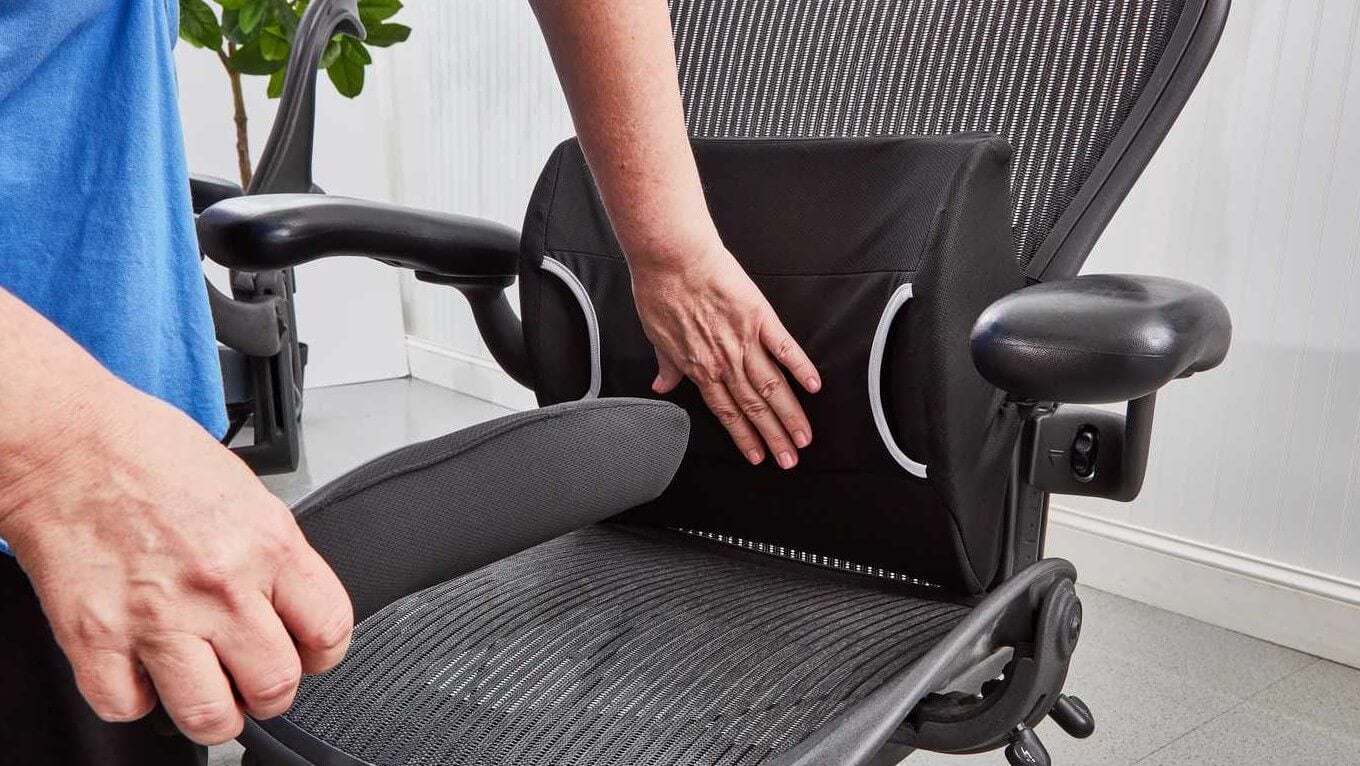
3. Adjustable Lumbar Support
The lumbar spine has a natural inward curve. When that curve is not supported during seated work, the lower back flattens, the pelvis rotates backward, and the intervertebral discs shift their load toward the nerve roots. A chair with adjustable lumbar support, ideally adjustable both in height and in depth or firmness, allows you to position support precisely where your L4-L5 or L5-S1 vertebrae sit, which is where sciatic nerve compression most commonly occurs.
Our post on office chairs with lumbar support covers the mechanics of lumbar support in detail if you want a deeper explanation before selecting a chair.
4. Forward Tilt Capability
A slight forward seat tilt opens the hip angle past 90 degrees, which reduces the stretch on the hamstrings and relieves some of the posterior pelvic tuck that compresses lumbar discs. Many people with sciatica find that a 5-to-10 degree forward tilt significantly reduces radiating leg symptoms during sustained desk work. Not all chairs offer this; it’s worth confirming before purchasing.
5. Adjustable Armrests (Height and Width)
This seems unrelated to sciatic pain until you consider the chain reaction. Armrests that are too high elevate the shoulders, which shifts the trunk forward and causes the lower back to lose contact with the backrest. Armrests that are too low cause the user to lean to one side to compensate, creating a lateral pelvic tilt that loads the piriformis muscle on one side. Piriformis tightness is a secondary cause of sciatic pain for many people. 4D adjustable armrests (height, width, depth, and pivot) give users the ability to eliminate both of these problems.
What to Avoid If You Have Sciatica
Hard, flat seats with no contouring. These create focal pressure directly under the ischial tuberosities (sitting bones) and against the back of the thighs, both of which can directly aggravate sciatic nerve pain.
Chairs without adjustable seat depth. One-size seat depth means the chair is right for some body types and wrong for others. For sciatica sufferers, a seat that’s even an inch too deep changes the entire postural equation.
Pure foam seats without a firm base layer. Very soft foam seats allow the pelvis to sink and tilt backward, flattening the lumbar curve and increasing nerve root compression. Look for chairs where the seat has a firm base layer with a cushioning layer on top rather than all-foam construction.
Chairs with non-adjustable lumbar support at the wrong height for your body. Fixed lumbar support positioned too high or too low doesn’t support the lumbar curve at all, and in some cases can create a focal pressure point that increases discomfort.
Chairs from Arenson That Are Worth Considering for Sciatica
We carry a broad selection of task and executive seating at our San Diego showroom, and several of them are particularly relevant for people managing sciatic or lower back pain.
Nightingale CXO Executive Chair
The Nightingale CXO is one of the chairs we recommend most often when customers come to us with specific back or sciatic complaints. It features a thoracic-lumbar pad that is adjustable in both height and depth, a waterfall seat edge, adjustable seat depth, and a recline tension control that allows users to set the chair to follow their movement rather than resisting it. The CXO is designed and manufactured with BIFMA certification and has a strong reputation in clinical and healthcare environments where user comfort under extended seated work is a genuine performance requirement, not a marketing point.
HON Ignition 2.0 Task Chair
The HON Ignition 2.0 is one of the more practical mid-range options for people who need genuine ergonomic features without an executive-tier price. It includes adjustable lumbar support, independently adjustable seat depth, and a synchro-tilt mechanism that allows the seat and back to recline together in a ratio that keeps the lumbar curve supported even when leaning back. It is available in both upholstered and mesh back configurations. Mesh is worth considering for people whose sciatica is aggravated by heat, since mesh significantly improves airflow and reduces seat temperature during long sessions.
HAG Sofi Task Chair
The HAG Sofi is a Scandinavian-designed task chair with a particularly distinctive feature: a seat that tilts and moves with the user rather than remaining fixed. This “active sitting” concept reduces the static loading on the lumbar discs and sciatic nerve roots that comes from sitting in exactly the same position for hours. For people whose sciatica is aggravated by sustained static posture, the Sofi’s movement-encouraging design can make a meaningful difference. It also features a waterfall seat edge and a backrest that follows the user’s movement independently.
YES Mesh Back Task Chair
For users who need good lumbar adjustability in a breathable format, the YES Mesh Back Task Chair offers a height-adjustable lumbar mechanism alongside a contoured seat and multiple recline options. It is a solid option for warmer office environments or for users who tend to run hot during the workday, since excessive seat heat can independently contribute to muscle tension in the lower back and hips.
Proline Big and Tall Mesh Back Chair
Sciatica and lower back pain are disproportionately common in taller and heavier individuals, partly because standard chairs are sized for a body type that excludes a significant portion of the working population. The Proline Big and Tall Mesh Back Chair accommodates users up to 400 pounds, features a taller backrest that properly supports the full lumbar and thoracic spine in larger-framed users, and includes adjustable lumbar support and wider seat dimensions. For users who have found that standard-sized chairs create off-center or inadequate support, this is a category worth exploring.
Browse the full chair selection on our office chairs page to see current availability.
How to Set Up Any Chair Correctly for Sciatica
Even the right chair won’t help much if it isn’t set up correctly. Here is a basic sequence for sciatica-specific chair setup.
Start with seat height. Your feet should rest flat on the floor with your knees at or just below hip level. Knees above hips tilt the pelvis backward and compress the lumbar curve. A footrest is worth using if your feet don’t reach the floor at the correct seat height.
Set seat depth next. Slide the seat depth so you have a two-to-three finger gap between the front edge of the seat and the back of your knee when sitting fully upright. This ensures the waterfall edge is doing its job and the lumbar backrest is within reach.
Adjust lumbar support height so the firmest point of the support sits at the natural inward curve of your lower back. For most people this is at or just above the waistband, around the L3-L5 vertebrae level.
Set armrest height so your shoulders stay level and relaxed when your forearms rest on them. Shrug your shoulders, let them drop naturally, and set the armrests to meet your elbows at that relaxed position.
For a fuller breakdown of workstation setup, our ergonomic desk setup guide walks through monitor placement, keyboard positioning, and break habits alongside chair setup, since sciatica responds to the whole picture, not just the chair in isolation.
Should You Use a Seat Cushion Instead?
We get asked this regularly, usually by people who have bought a chair that doesn’t fully work for them and are looking for an inexpensive fix.
The short answer is that a quality seat cushion can help as a supplement but not as a replacement for a chair with proper adjustability. Coccyx-cutout cushions (which relieve pressure at the tailbone and base of the spine) and memory foam cushions with a firm base layer are the two types most commonly recommended for sciatica by occupational health practitioners. They can meaningfully reduce local pressure when added to a chair that otherwise fits well.
What they can’t fix is a seat that’s the wrong depth, lumbar support at the wrong height, or armrests that are causing lateral postural compensation. If you’re relying on a cushion to compensate for a fundamentally poor-fitting chair, the better investment is usually the chair.
Other Factors That Affect Sciatica at the Desk
Movement frequency. Sustained static sitting is the main driver of sciatic aggravation, and no chair eliminates that entirely. Standing or walking for two to five minutes every 30 to 45 minutes is one of the most effective interventions for reducing daily sciatic symptoms during desk work. A height-adjustable desk makes this easier. See our height adjustable desks if this is part of your setup plan.
Monitor height. A monitor positioned too low causes the head to drop forward, which creates a chain-reaction tension through the thoracic spine and into the lumbar region. For people with sciatic pain in the L4-S1 range, this secondary tension matters.
Wallet and phone in back pockets. This sounds minor but isn’t. Sitting on a wallet or phone tilts the pelvis asymmetrically and loads the piriformis on one side, which is a documented secondary trigger for sciatic nerve compression. Empty your back pockets before you sit down.
Frequently Asked Questions
What type of office chair is best for sciatica?
A chair with adjustable seat depth, adjustable lumbar support, a waterfall seat edge, and forward tilt capability addresses the specific postural problems that aggravate sciatic nerve compression. The exact model matters less than whether these features are present and properly adjusted for your body.
Is a harder or softer seat better for sciatica?
Neither extreme is ideal. A very hard seat creates focal pressure under the sitting bones. A very soft foam seat lets the pelvis sink into a posterior tilt that flattens the lumbar curve. The best option is a seat with a firm structural base and a moderate cushioning layer on top, ideally with a waterfall front edge to reduce thigh pressure.
Does a standing desk help with sciatica?
Alternating between sitting and standing reduces the total duration of sciatic nerve compression per day, which most people find helpful. Standing in one position for extended periods can also aggravate sciatica, so the value is in the alternation, not in standing itself. An anti-fatigue mat is worth adding to any standing desk setup.
Can a chair cause sciatica?
A chair doesn’t cause sciatica in a clinical sense, since the condition originates in the spine or piriformis muscle. But a poorly fitting chair can significantly worsen existing sciatic symptoms and, over time, contribute to the postural patterns and disc wear that predispose people to sciatic nerve compression.
How long does it take for the right chair to reduce sciatica symptoms?
Most people notice a reduction in end-of-day pain within one to two weeks of switching to a well-fitted chair. Radiating leg symptoms during the workday may reduce more gradually. If symptoms worsen after switching chairs, revisit the setup sequence above before concluding the chair isn’t working.
Where to Go From Here
If you’re in San Diego and want to try chairs before buying, we encourage it. Sciatica is specific enough that the difference between a chair that helps and one that doesn’t often becomes clear within 10 minutes of sitting in it correctly. Our team at Arenson can walk you through the adjustment process on any chair in our showroom and help you compare options based on your specific pain pattern and body type.
Visit our locations page for our showroom address and hours, browse our full office chair selection online, or read our complete office chair buying guide if you want to compare chair types side by side before you visit.
LATEST POSTS
Breakroom & Employee Lounge Furniture Ideas That Support Retention
August 10th, 2026 | Office Furniture Blog
Most companies treat the breakroom as an afterthought. A fridge, a folding table, a few mismatched chairs, done. But the breakroom is one of the only spaces in the office where employees are not performing for anyone. That makes it one of the most honest signals of how a company actually treats its people, and…
Read MoreLaw Office Furniture: Essential Pieces for a Professional Practice
July 27th, 2026 | Office Furniture Blog
Clients judge a law firm before an attorney ever says a word. The reception desk, the conference table, the chair a client sits in while discussing a divorce or a lawsuit: every piece sends a signal about competence, discretion, and trust. For a legal practice, furniture isn’t decor. It’s part of the case for hiring…
Read MoreGaming Chair vs. Office Chair: What’s the Difference?
July 17th, 2026 | Office Furniture Blog
The short answer: gaming chairs are designed for aesthetics and marketing. Office chairs are designed for the human body during extended sitting. If you work at a desk for six or more hours a day, that difference matters more than most people realize before they buy. We get asked about this at Arenson regularly, usually…
Read More